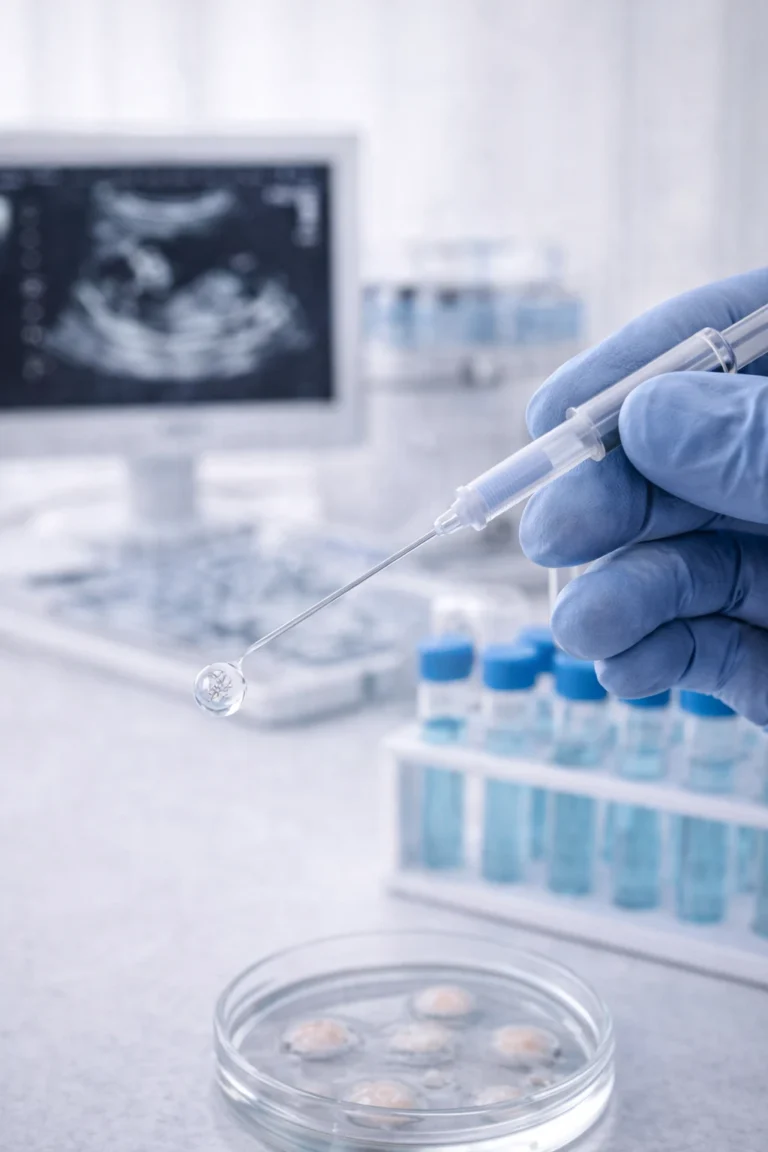
Secure your reproductive future with embryo freezing
Whether you’re facing fertility challenges or simply want to defer parenthood, embryo freezing provides you with a valuable safety net, giving you the flexibility to pursue your dreams at your own pace.
Embryo freezing, also known as embryo cryopreservation, is a fertility preservation technique that involves the safe and controlled freezing of embryos created through in vitro fertilisation (IVF) for future use. This enables individuals or couples to preserve their embryos for later pregnancy attempts, even if they are unable to conceive immediately or if their fertility declines over time.
The embryo freezing process typically involves the following steps:
Patients undergoing preimplantation genetic diagnosis (PGD) typically freeze their embryos following the test because the findings can take up to a week to arrive.
Embryo freezing is a valuable option for individuals or couples who fall into one or more of the following categories:
No, egg freezing and embryo freezing are two different fertility preservation techniques. Egg freezing involves preserving unfertilised eggs, while embryo freezing involves preserving fertilised eggs, also known as embryos.
Embryos are frozen as part of an IVF cycle, so the timing follows your treatment rather than a separate schedule. Any good quality embryos that are not transferred in a fresh cycle can be frozen for later use. Because embryo quality is closely linked to the age of the eggs they were created from, embryos created at a younger age generally offer better prospects when they are used later.
Embryo freezing offers several benefits for individuals and couples considering fertility preservation:
Embryos can be frozen for an indefinite period of time while maintaining their viability for use. However, the longer they are frozen, the more likely it is that some will not survive the thawing process.
Pregnancy rates from frozen embryo transfer are broadly comparable to those from fresh transfer. In a frozen transfer cycle the lining of the womb is prepared without ovarian stimulation, which some clinics consider helpful for implantation.
Success depends on a number of factors, including the age of the woman at the time the eggs were collected, the quality of the embryos before freezing, how many embryos survive thawing, and the freezing technique used by the clinic. Your clinic can give you figures based on your own situation.
No. No fertility treatment can guarantee a pregnancy. Freezing embryos does, however, give you further opportunities to attempt pregnancy without going through another full stimulation and egg collection cycle.
Embryo freezing is a generally safe procedure with minimal risks. However, some potential risks include:
No medication is required to freeze embryos. They are simply cryopreserved using specialized techniques.